

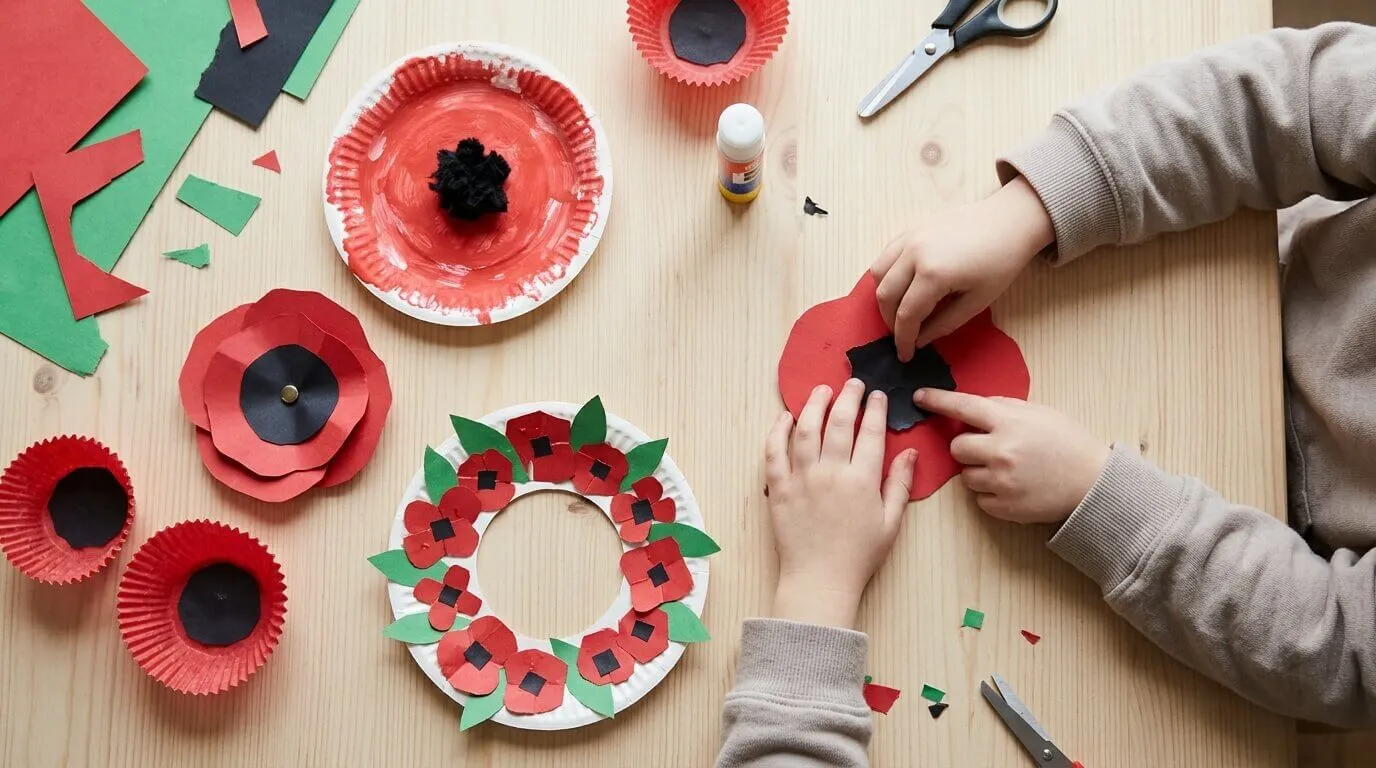
My son asked me last November why everyone at school was wearing a red flower. I started explaining, got about three sentences in, and realized I didn’t have a good answer for a five-year-old. So we got out the red paper, made a poppy at the kitchen table and talked about it while we glued, which turned out to be a much easier way into the whole thing for both of us. We’ve done it every year since.
These are the Remembrance Day crafts for kids we’ve collected, sorted by age, with free templates for the poppies, a wreath and a thank-you card. They work whether you call it Remembrance Day, Armistice Day or Veterans Day. And they work at the kitchen table or with a whole class.
Remembrance Day or Veterans Day?
It depends where you live, and they’re not quite the same day in spirit.
| Where | What it’s called | 2026 date | The silence |
| UK | Remembrance Sunday | Sunday 8 November | Two minutes at 11 am |
| UK | Armistice Day | Wednesday 11 November | Two minutes at 11 am |
| Canada | Remembrance Day | Wednesday 11 November | Two minutes at 11 am |
| Australia | Remembrance Day | Wednesday 11 November | One minute at 11 am |
| US | Veterans Day | Wednesday 11 November | No set silence |
Remembrance Day is about remembering the people who died in wars. In the US, Veterans Day is about thanking everyone who has served, and most of them are very much alive. (Americans remember the fallen on Memorial Day, in May.) So for UK, Canadian and Australian kids, the poppy is the big symbol. For American kids, a thank-you card for a veteran is the heart of it.
How to Explain It to Young Kids
Here’s something short you can read out loud. It’s honest without being scary.
A long time ago, there was a very big war. Lots of countries were fighting, and lots of soldiers were far from home. On the 11th of November, at 11 o’clock in the morning, the fighting stopped. Now, every year on that day, people stop what they’re doing and stay quiet for a minute or two. They think about the people who went away to the war and didn’t come home, and about everyone who helps keep us safe. Many people wear a red poppy, because poppies grew in the fields where the soldiers were.
Don’t worry about getting it perfect. If your kids ask harder questions, it’s fine to say “that’s a good question, let’s find out together.” Older kids often want the real history, and that’s when the poem “In Flanders Fields” is worth reading with them.
Remembrance Day Crafts for Kids Ages 3 to 5
1. Thumbprint Poppy Field
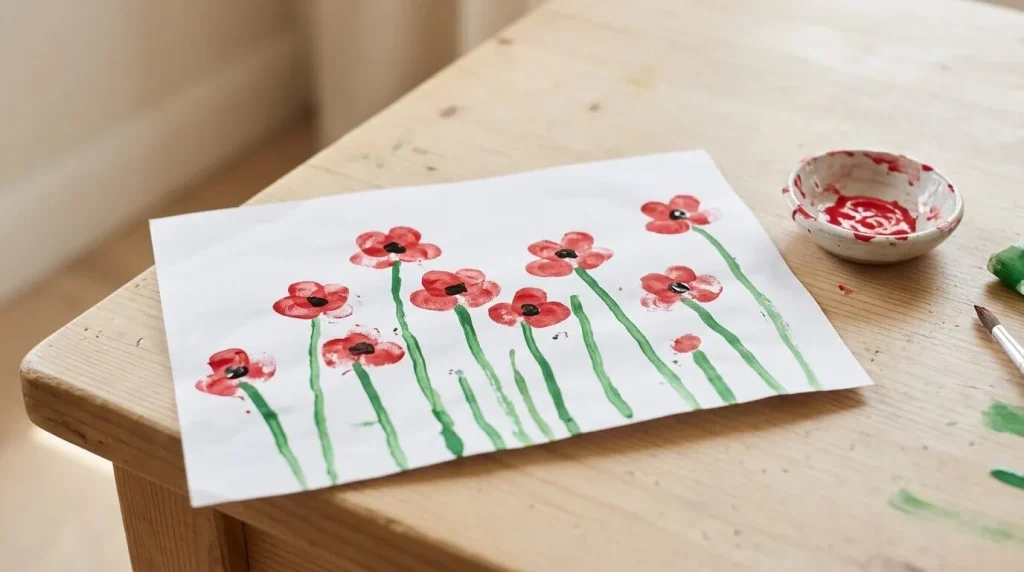
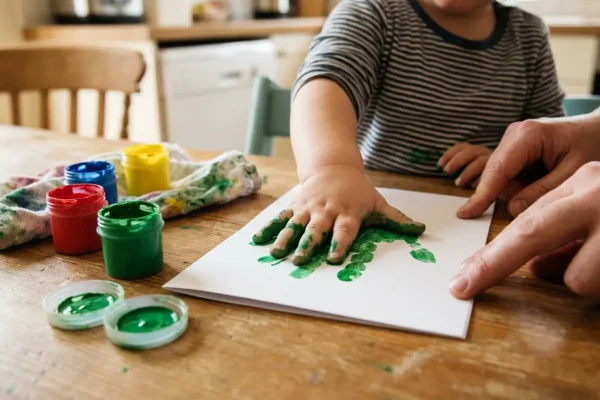
Draw a few green stems on paper. Kids dip a thumb in red paint and press it at the top of each stem, then add a black dot in the middle with a fingertip once it’s dry. It takes ten minutes and looks lovely in a row on the fridge. Ours stayed up till Christmas.
2. Paper Plate Poppy
Paint a paper plate red. When it’s dry, glue a black paper circle in the middle and cut a few small slits around the edge so it looks like petals. Little ones can do the painting; you do the snipping.
3. Cupcake Liner Poppy
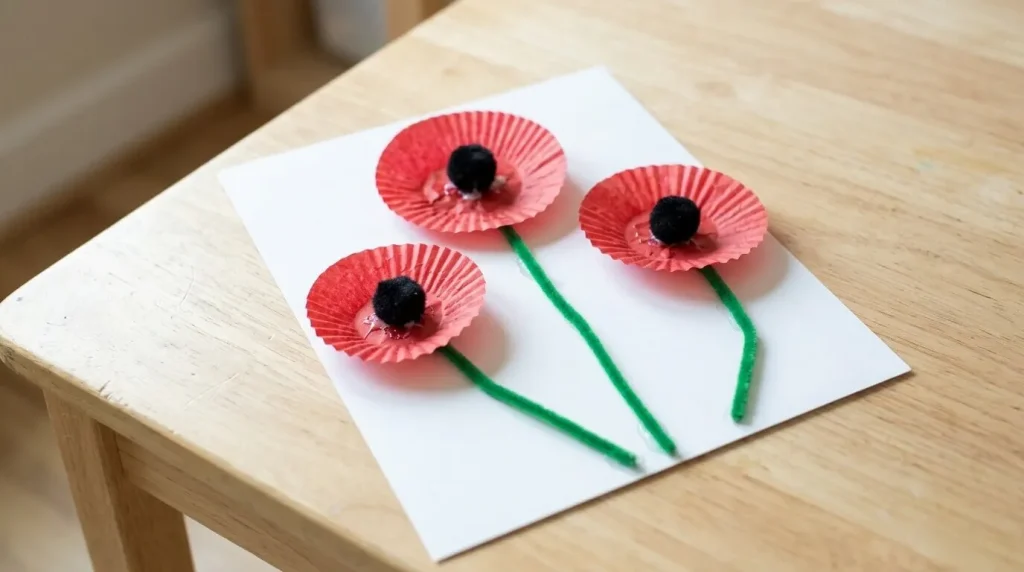
Flatten two red cupcake liners, glue one on top of the other, and stick a black pom-pom or a black paper circle in the center. Add a pipe cleaner stem. They’re soft and crinkly, and toddlers love squashing them flat.
4. Poppy Coloring Page
Our template has big, simple poppies with wide petals, so small hands don’t have to color inside tiny gaps. It’s a quiet one for the morning of the silence.
Ages 6 to 8
5. Layered Paper Poppy
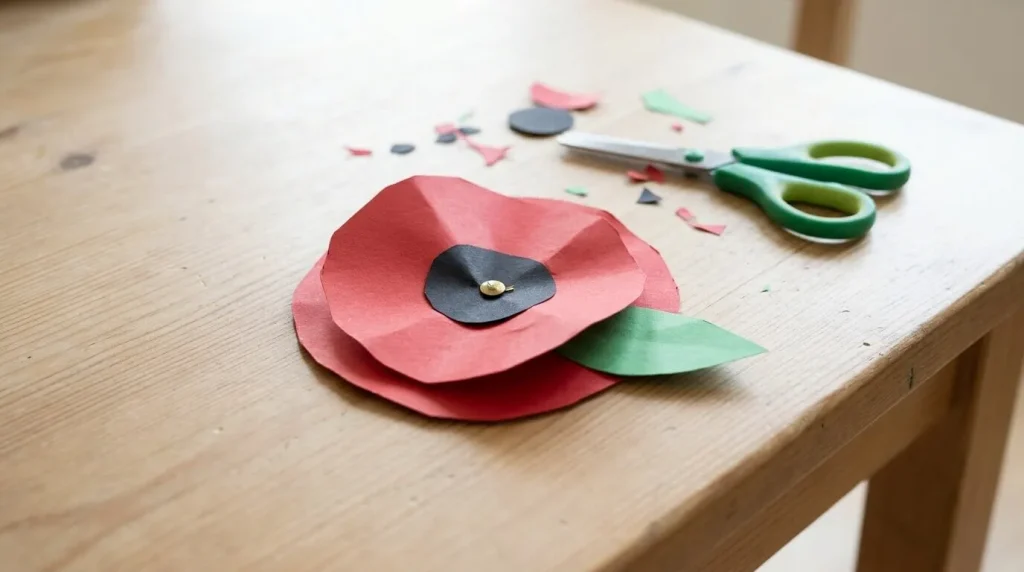
Cut out the two petal layers and the center from our template. Fold the petals up slightly, stack them, and push a split pin (a brad) through the middle. The petals turn, which kids find weirdly satisfying. Mine spun his for twenty minutes.
6. Egg Carton Poppies
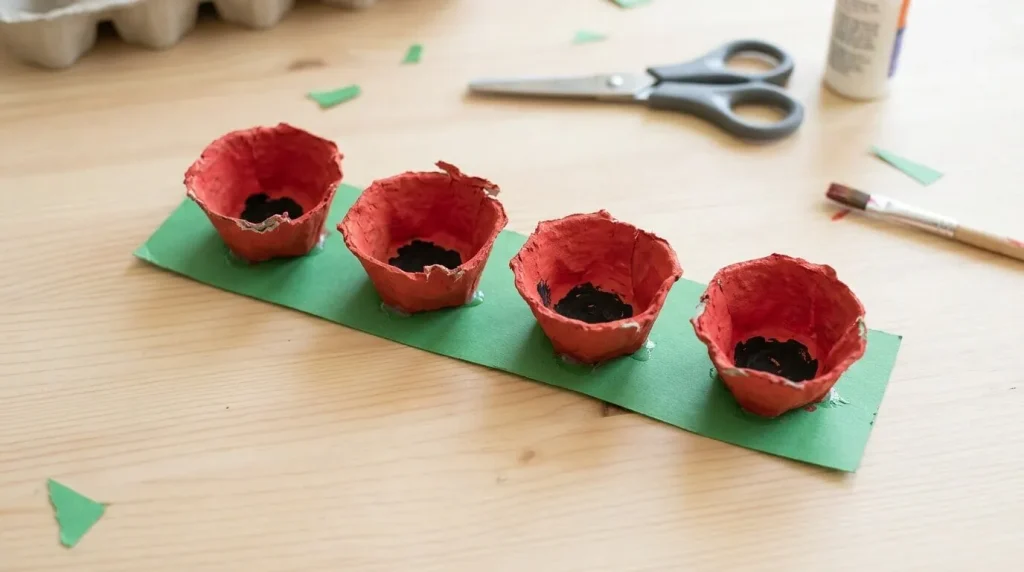
Cut the cups out of a cardboard egg carton, trim the edges into petal shapes, and paint them red with a black center. Glue a few onto a strip of card for a little poppy garden. It’s messy. That’s fine.
7. Paper Plate Poppy Wreath
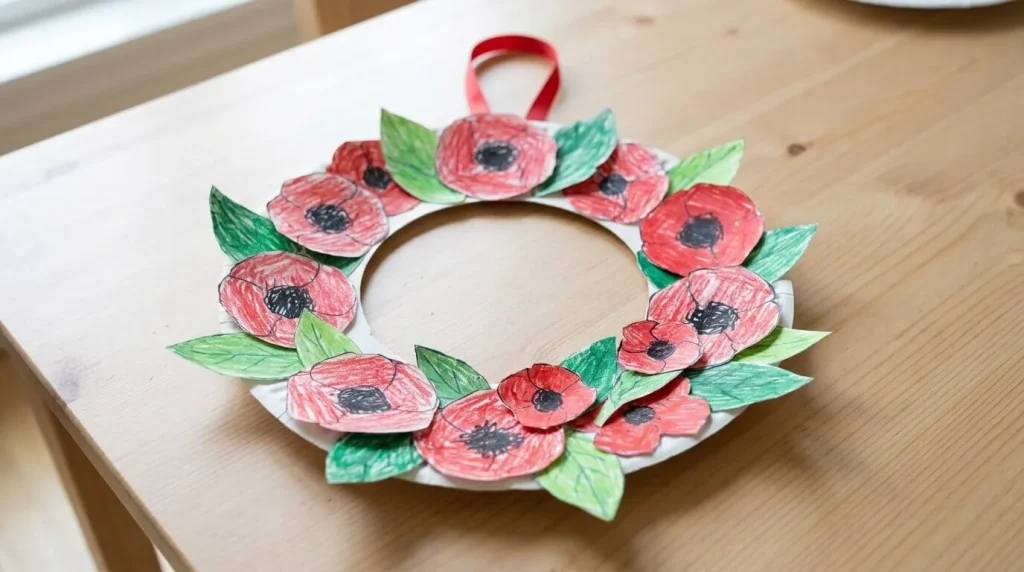
Cut the middle out of a paper plate so you’re left with a ring. Glue the poppies and leaves from our template all the way around. Wreaths are laid at memorials on Remembrance Sunday, so this one ties the craft to what kids will see on the news.
8. Thank-You Card for a Veteran
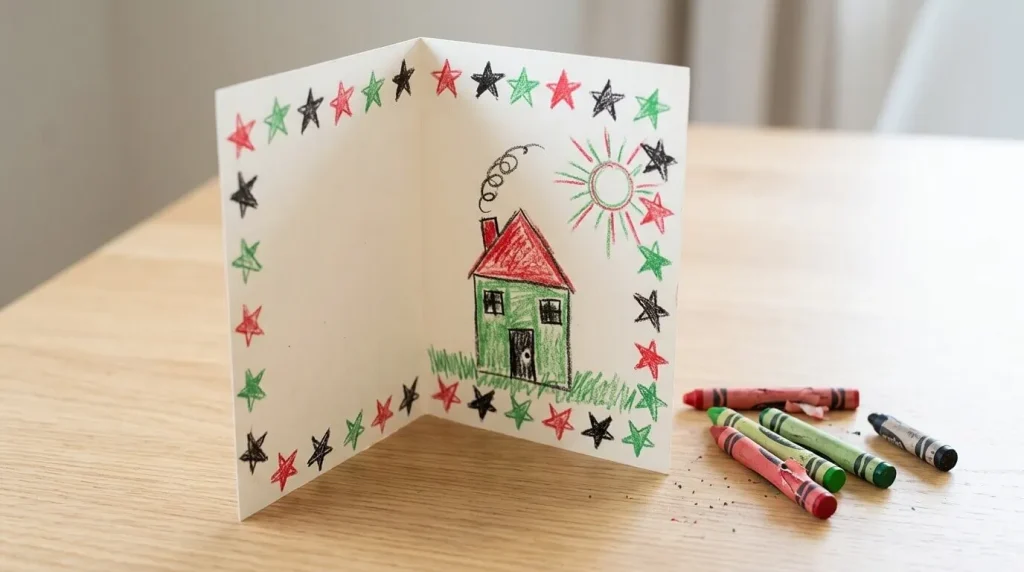
Our template folds into a card with a star border and space inside for a message or a drawing. If you know a veteran, give it to them in person. If you don’t, see the section on sending cards below.
Ages 9 to 12
9. Painted Stone Poppies
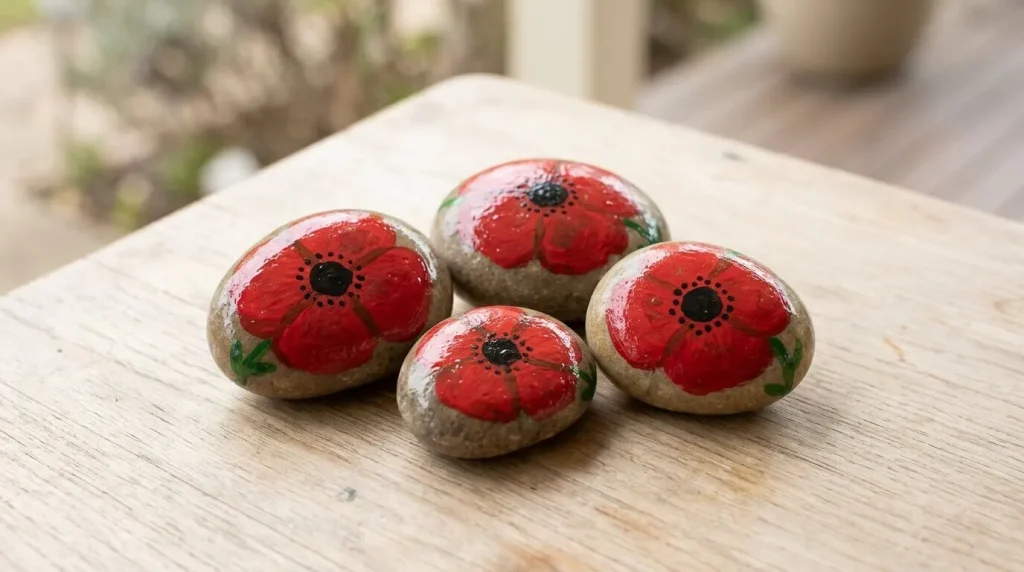
Wash and dry a smooth flat stone, paint it red with a black center, and seal it with clear varnish or Mod Podge. Don’t skip the varnish. The Royal Canadian Legion suggests placing painted poppy stones at a veteran’s grave. Check the cemetery’s rules first; some ask visitors not to leave items.
10. Poppy Window Display
Older kids can cut a row of poppies from our template, color them, and tape them across a window facing the street. It’s a quiet way to join in that the whole neighborhood can see, and if you walk around the block on the morning of the 11th you’ll probably spot a few other windows doing the same thing.
11. Felt Poppy Pin
Cut two red felt petal layers and a black felt center using our template as a pattern. Stitch them together with a few stitches through the middle and sew a safety pin on the back. It’s a good first sewing project, and kids are very proud to wear something they made.
12. Star Garland for Veterans Day
Cut out the stars from our template, write one word of thanks on each (“brave”, “kind”, “thank you”), and string them together. Hang it by the front door on 11 November.
The 11 O’Clock Silence
The silence is the part kids remember. A minute is a long time when you’re six. It’s long for grown-ups too, honestly. So practice once the day before: set a timer, sit still, and see how it feels. On the day, stop at 11 am wherever you are. In the UK and Canada it’s two minutes; in Australia it’s one. Younger kids can hold their poppy and look at it, which helps, and if they wriggle or whisper halfway through, that’s completely normal and nobody will mind one bit.
If you’re in the US, there’s no official silence for Veterans Day, but some families and schools pause anyway. It’s a nice thing to do before giving a card.
Sending Cards to Veterans
If you’d like your kids’ cards to reach veterans they don’t know, Operation Gratitude runs a letter writing program for veterans, troops and first responders. Read their current guidelines before you send anything. The main ones: no glitter, first names only for children, no individual envelopes, and an age on each drawing. Cards go together in one big envelope or box to the address on their site.
You can also ask at a local veterans’ home or a Legion branch. Call first, because many have their own rules about cards and visits. Some will say yes on the spot.
Download the Free Templates
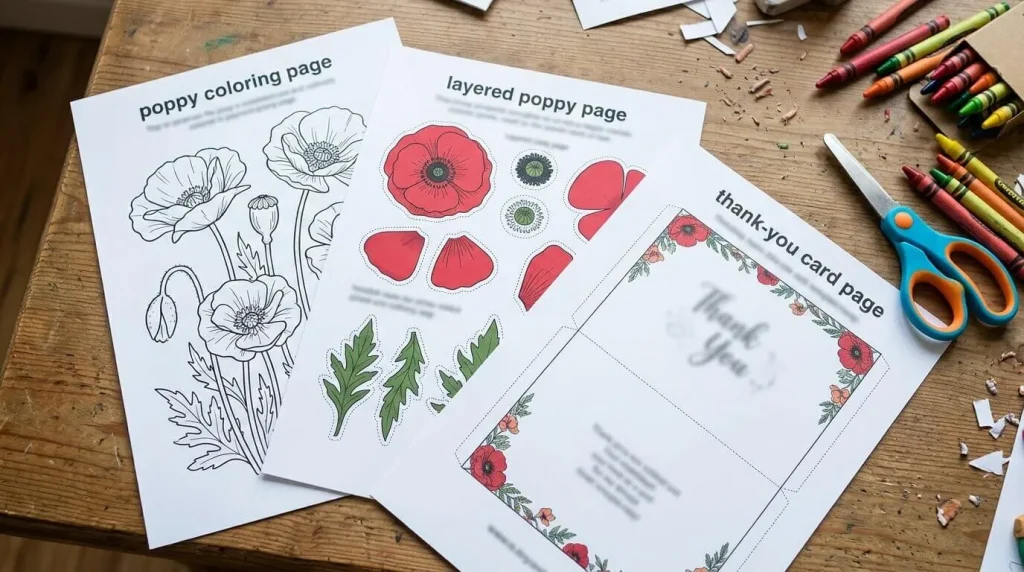
The free PDF has templates for these Remembrance Day crafts for kids: a poppy coloring page, the layered poppy pieces, poppies and leaves for the wreath, the thank-you card, the felt poppy pattern, and the star garland. It prints on US Letter and A4.
Download the Free Printable
⬇ Download PDF (Free)More Seasonal Crafts
FAQs
When is Remembrance Day in 2026?
Remembrance Day is on Wednesday 11 November 2026 in Canada, Australia and the UK, where it’s also called Armistice Day. The UK holds its main services on Remembrance Sunday, which is 8 November this year. In the US, 11 November is Veterans Day. It’s on the 11th every year because that’s the day the First World War fighting stopped in 1918.
What’s the difference between Remembrance Day and Veterans Day?
Remembrance Day remembers the people who died in wars, and the poppy is its symbol. Veterans Day in the US thanks everyone who has served in the military, and it’s mostly about the veterans who are still with us. Americans remember the fallen separately, on Memorial Day in May. So a poppy fits Remembrance Day best, and a thank-you card fits Veterans Day best.
How do you explain Remembrance Day to a preschooler?
Keep it short and calm. Tell them there was a big war long ago, it stopped on 11 November, and now people are quiet for a minute to remember the soldiers who didn’t come home. Making a poppy while you talk helps, because their hands are busy and the questions come naturally. You don’t need to give details they haven’t asked for.
Why do people wear poppies?
Red poppies grew across the battlefields in Belgium and France during the First World War. A Canadian doctor, John McCrae, wrote the poem “In Flanders Fields” about them in 1915, and the poppy became the flower of remembrance. People in the UK, Canada and Australia wear one in the weeks before 11 November. In the US, poppies are worn more around Memorial Day.
What are easy Remembrance Day crafts for kids?
The thumbprint poppy field, paper plate poppy and cupcake liner poppy are the easiest, and they work from age 3. They need only paper, paint, glue and a few liners. For older kids, the layered paper poppy and the felt poppy pin take a bit more patience. Most of them have a free template in our PDF.
Can kids send cards to veterans?
Yes. Operation Gratitude collects letters and drawings for veterans and service members, and they have clear rules: no glitter, first names only, and no individual envelopes. Check their website for the current address and guidelines before mailing. You can also call a local veterans’ home and ask if they’d like cards.

Leave a Reply